Resource planning for creative agencies: a practical guide
By Huw Cushing, Founder, Sprintora · · 6 min read

Resource planning for creative agencies comes down to one question: who is doing what, and when, and is that enough? In a studio where people sit across three jobs at once, the answer needs a shared view. Memory runs out somewhere around the fifth live project, and the person holding the plan in their head becomes the bottleneck.
This guide sets out a practical way to plan resources in a studio of 10 to 50 people: the steps, the numbers to watch, and the mistakes that cause the Monday morning scramble.
What resource planning is for
A resource plan has three jobs. It shows whether the work you have sold can be delivered with the people you have. It shows who is overbooked and who has room. And it gives the studio a place to make trade-offs on purpose, such as moving a deadline, bringing in a freelancer or saying no to a pitch.
Without a plan, those trade-offs still happen. They just happen by accident, usually on a Thursday, and usually at the expense of whoever is least likely to complain.
Step 1: List the work
Write down every live project, retainer and pitch. For each one note the dates, who the client contact is, and the hours you expect from each discipline: design, development, strategy, project management.
Start with what you have sold, then add work you expect to win. Keep the two visibly separate. A pitch at 30% likelihood should not take 100% of a designer's week. Many studios mark unconfirmed work as tentative so it shows up without claiming capacity it may never use.
Step 2: Work out real capacity
Capacity is not working hours. It is working hours minus everything that is not project time: approved leave, public holidays, sick days, internal meetings, admin, training and the unbillable work of leading a team.
A person with 38 working hours in a week might have 28 to 32 hours of real project capacity. Planning against 38 is the quickest way to overbook a team.
The calculation is simple but needs the data: leave calendars, public holidays by location, and bookings on other projects. If the data lives in four places, the plan will always be a week behind.
Step 3: Match skills to tasks
A task needs a skill, not just a body. A motion designer cannot cover a backend task because they happen to have a free afternoon. When you plan, put the person with the skill and the time. Where the skill exists in only one person, treat that person as a constraint and plan around them first.
Keeping a simple list of skills per person, even five or six tags each, makes this faster and reveals single points of failure. If only one person can do a type of work, that is a risk worth knowing about before they go on leave.
Step 4: Look at the whole studio at once
Planning one project at a time hides the clash. Each project looks fine on its own. Put them all on one view and you see the designer who is 60% on one job, 50% on another and 40% on a third.
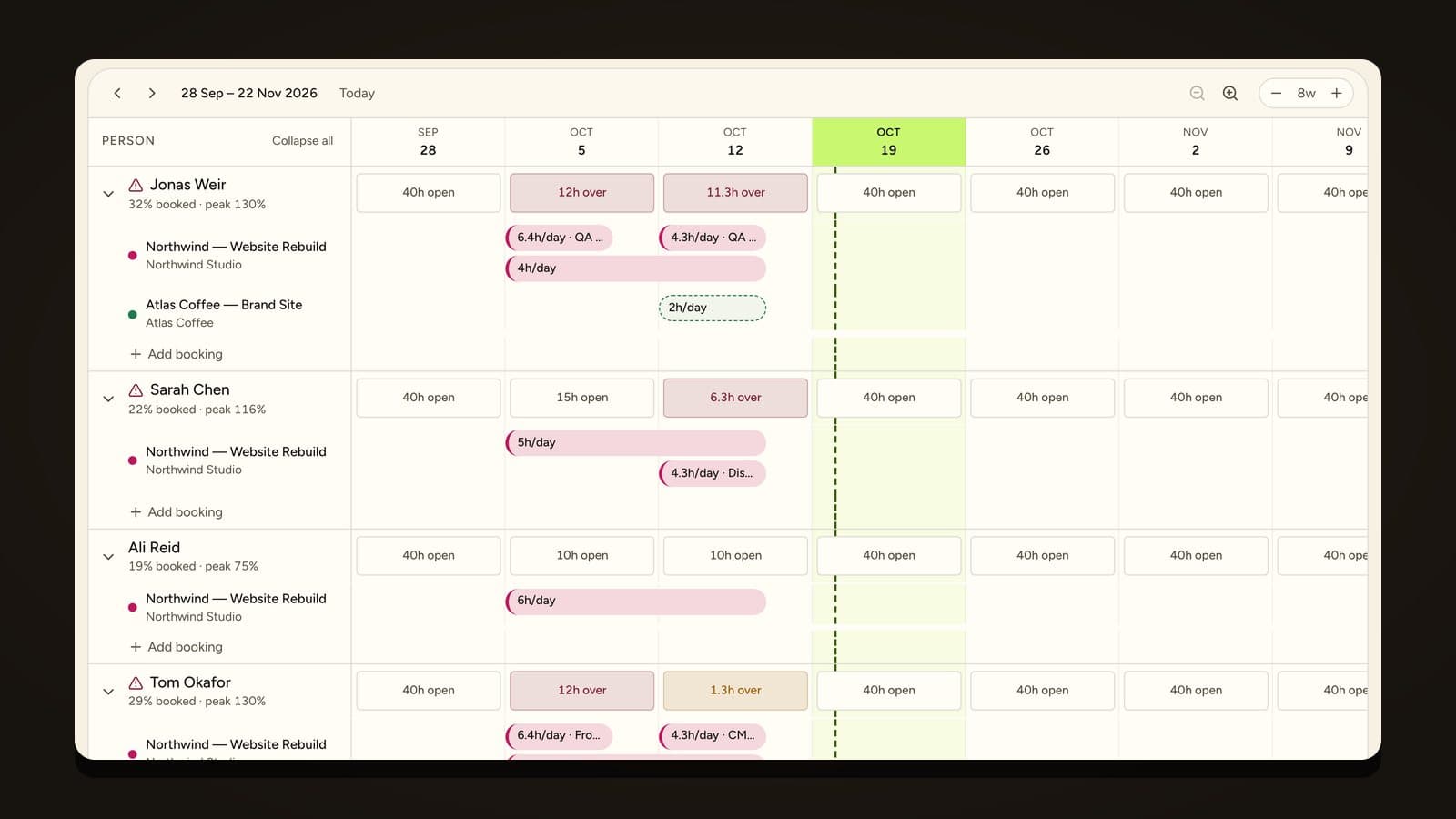
A studio-wide view, usually a timeline with people down the side and weeks across the top, shows who is overbooked this week and who has room. It also shows the gaps coming in six weeks, which is useful for sales as much as for delivery.
Look ahead further than you think you need to. Detail is useful for the next two to four weeks. A rougher view out to a quarter tells you when to hire, when to say yes to more, and when to be careful.
Step 5: Plan, review, adjust
A plan is a draft that gets edited. The first version is never right. Sit down with team leads, check it against what they know, and fix what is wrong. Then share it. A plan nobody sees is a guess.
Revisit it weekly. Work comes in, estimates change, someone is off sick. A short weekly rhythm keeps the plan close to reality, which is more useful than a perfect plan made once a month.
The 30 minute weekly planning routine lays out a format for this.
The numbers worth watching
Three measures cover most of what a producer needs.
Planned load per person, as a percentage of real capacity. Past about 90% is overbooked. The guide to spotting an overbooked team covers early signs.
Free capacity by week, per discipline. This is what the sales conversation needs.
Forecast margin per project. Plans cost money, and the plan is where you can still change cost. A plan that ignores cost is a calendar.
Common mistakes
Planning to 100% of hours. There is no slack for leave, feedback or a late brief.
Ignoring non-project time. Leading, hiring, pitching and training are real work and need to be in the numbers.
Planning without cost. If your plan cannot show margin, you will find out about margin problems from your accountant.
Letting the plan live with one person. If the producer goes on leave and nobody else can read the plan, you do not have a plan.
Keeping the plan separate from time tracking. When planned and actual hours live in different tools, the comparison that makes next quarter's plan better never happens.
Where Sprintora fits
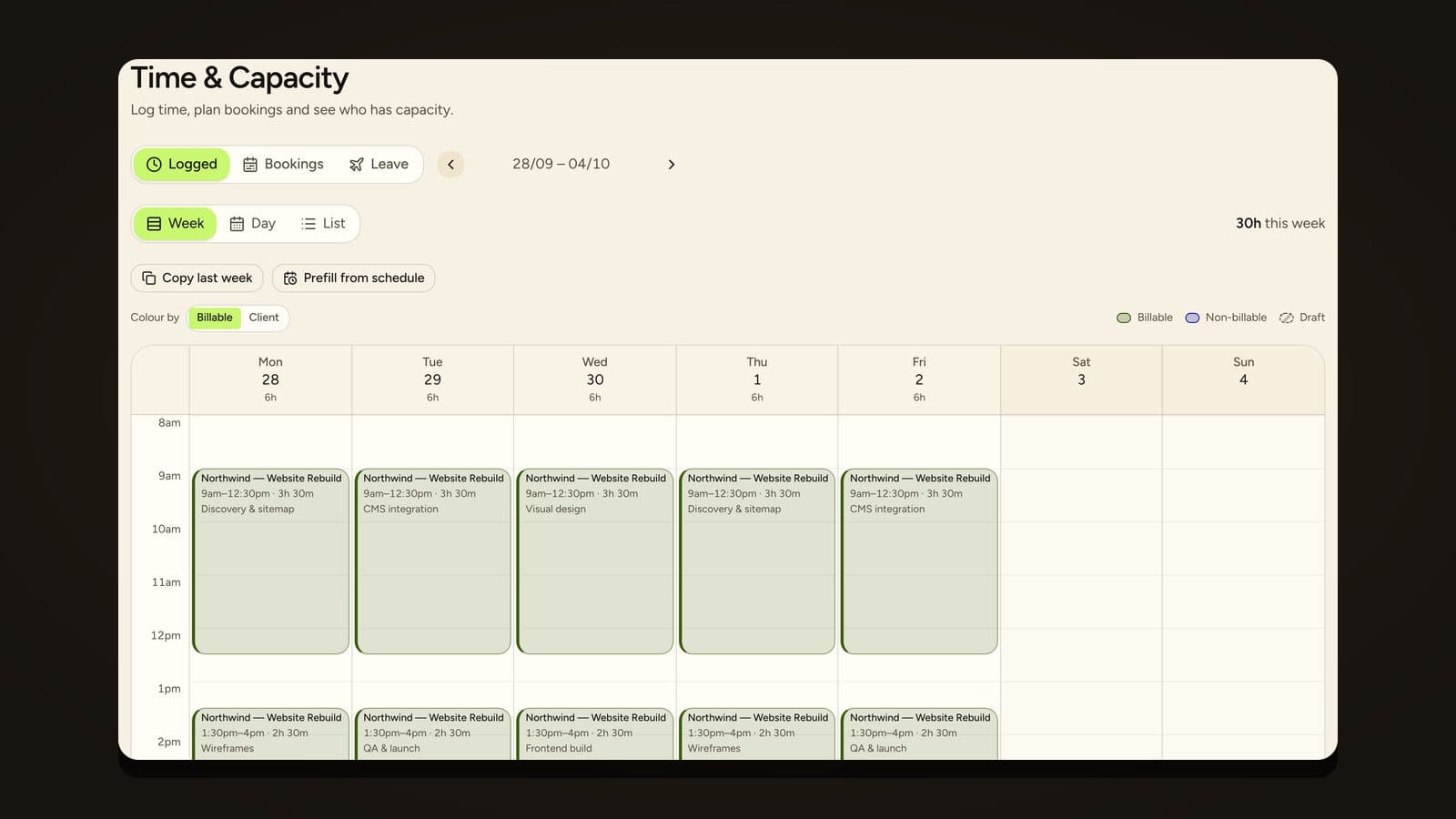
Sprintora's Schedule shows every project across the studio, from 4 to 52 weeks ahead. AI drafts each week around real capacity, with approved leave and bookings on other projects taken off, and around skills. Anyone planned past 90% is flagged as overbooked, with a suggested fix such as moving two tasks to people who have room. You review the draft, and nothing changes until you apply it. Time tracking is built in, so planned and actual hours sit side by side and every confirmed hour updates the project's margin.
Frequently asked questions
What is resource planning in a creative agency? It is the process of deciding which people work on which projects, and when, so that sold work can be delivered without overloading the team. It combines capacity, skills, deadlines and, ideally, cost.
How far ahead should an agency plan resources? In detail for the next two to four weeks, and in outline out to a quarter. Longer views help with hiring and sales. Shorter views drive the week.
Who should own resource planning in a studio? Usually a producer or studio manager, with team leads reviewing. One person owns the plan so it stays coherent, and the leads keep it honest.
How do I plan for work I have not won yet? Mark it as tentative so it shows in the plan without taking capacity you may never need, and adjust as the pitch moves.
Do I need resource planning software? Not at the start. A shared sheet can carry a small studio. Once you have a dozen live projects, leave across the team and a mix of retainers and fixed fees, a tool that knows capacity, skills and cost saves more time than it costs.
Founding studios get Sprintora free until 31 March 2027, then A$12 per planned person per month. See pricing.