Fixed-fee project profitability: where margin leaks and how to catch it early
By Huw Cushing, Founder, Sprintora · · 5 min read
Fixed-fee project profitability depends on one thing more than any other: how early you notice the drift. On a fixed fee, every extra hour comes out of your margin, and nobody has to make a mistake for that to happen. The leaks are small, they happen in the first half of the project, and they tend to be invisible until the invoice goes out.
This guide covers where margin leaks on fixed-fee work, the weekly check that catches it, and how to bring scope back to the client without turning it into a fight.
Why fixed fees are harder than they look
A fixed fee transfers risk from the client to you. In return you get predictability on the invoice and the chance to earn a good margin if you run the work efficiently. That trade is fine when the scope is clear and your estimate is sound. It becomes expensive when either one is soft.
Studios often compare fixed fee to time and materials as if they were pricing methods. They are also two different risk arrangements. On time and materials, scope drift is the client's cost. On a fixed fee, it is yours.
Where margin leaks
Scope drift through small asks
A new page here, an extra variant there. Each one is quick, so nobody raises a change request. Twenty quick asks across a project add up to a week of work, and none of it was on the quote.
Rounds of feedback
The fee covered two rounds. The client gives a third, then a fourth, because nobody wrote down what a round is. A round has a definition (consolidated feedback, one set of changes) or it has no limit.
Weak handovers
A brief that arrives half-finished costs a senior person a day of rework. Handovers between design and development, or between account and delivery, are where hours go missing.
Unbudgeted meetings
Client calls that run over, internal check-ins that grow, standing meetings with ten people. They are real hours with no line in the budget.
Late discovery
All of the above is survivable if you see it in week two. The version that hurts is the one you find at month end, when the budget is spent and the work is not finished.
The weekly check
Once a week, for each live fixed-fee project, look at three things.
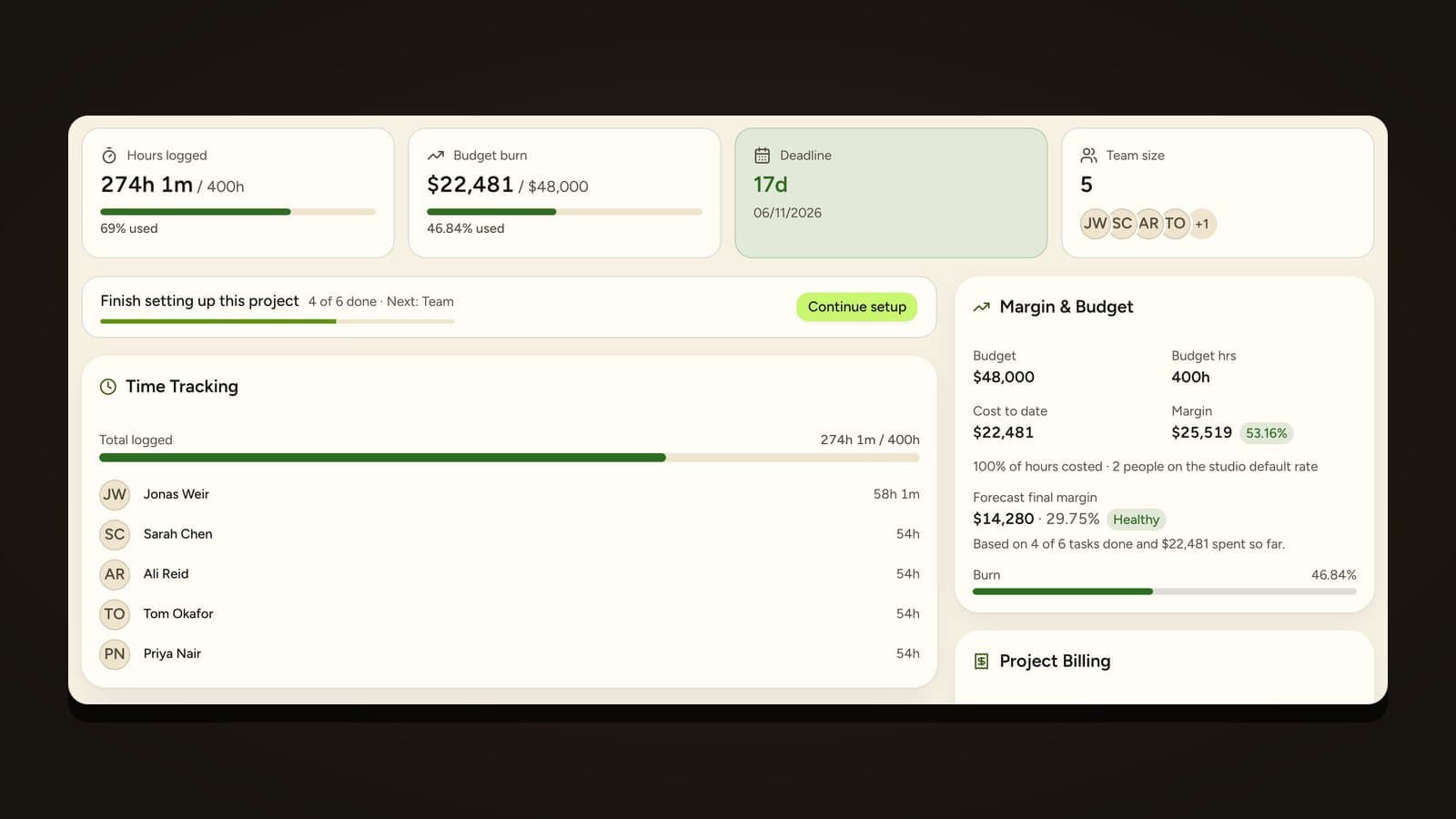
Cost to date against the fee. If the fee is A$40,000 and cost to date is A$18,000, you have used 45%.
Share of work done. Be honest. If the share of work finished is lower than the share of budget used, the project is burning faster than it progresses.
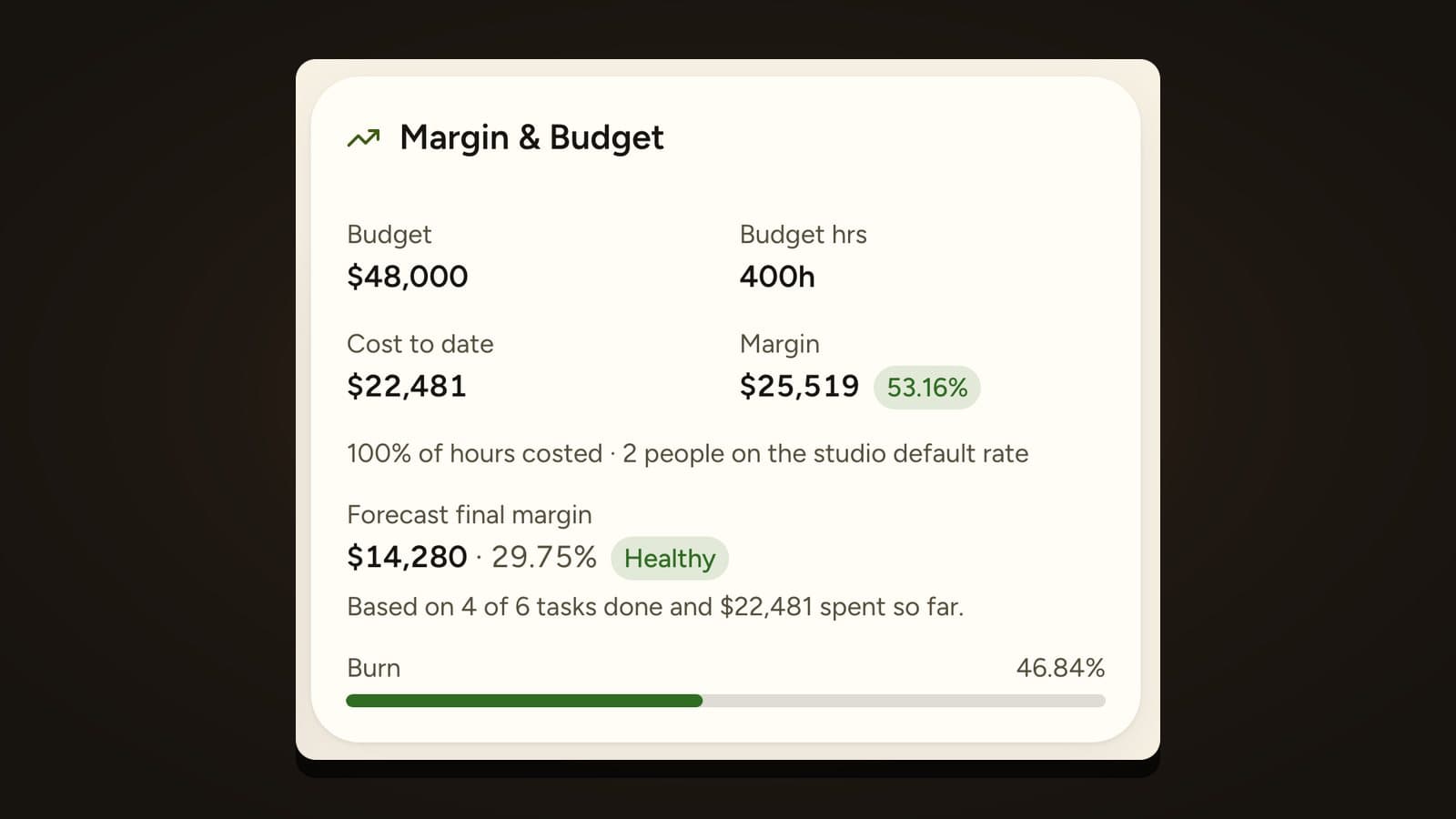
Forecast final margin. Take cost to date, divide by the share of work complete to estimate the final cost, then compare with the fee. The project margin guide has a worked example.
If budget used is ahead of work done by more than a few points, act that week.
What to do when burn runs ahead
You have four options and they are not mutually exclusive.
Re-plan. Look at who is doing what. Move work to people with a lower cost rate where it makes sense, and take expensive hours off the tasks that do not need them.
Cut scope. Agree with the client what comes out to protect the date and the budget. Clients often accept this more readily than studios expect when the options are put plainly.
Raise a change request. If the client added work, say so, show the original scope, and price the extra.
Accept it on purpose. Sometimes you decide the relationship is worth a lower margin on this project. That is a choice. It only counts as a choice if you made it in week four, not week twelve.
How to raise scope with a client
Bring facts, not feelings. A short note with three parts works: what the original scope said, what has been requested since, and the options. For example, "The brief covered two rounds of changes on the homepage and four template designs. We are now on round three, and two extra templates have been requested. We can absorb the extra round and swap the templates for later, or price both as a change." Clients respond to clear options far better than to a complaint.
Write the definition of a round and what triggers a change request into the proposal. It is much easier to point at a line than to introduce a rule midway.
Set a burn alert
A burn alert at 85% of budget leaves enough room to react. At 85% you still have 15% of the budget and time to decide. At 100% you have only apologies. Sprintora sends a burn alert at 85% and shows the forecast final margin on each project, so the check is already on the page when you look.
Price the next one better
Margin lessons from live projects belong in your estimates. After each fixed-fee project, record estimated hours against actual hours by phase. Within a handful of projects you will see where your estimates run light: usually discovery, feedback rounds and project management. Add those phases to the next quote on purpose.
Frequently asked questions
What is a good margin on a fixed-fee project? Decide your target before the project starts, working back from your overheads and the profit you need. A target fixed in advance beats a benchmark from elsewhere, because your costs are your own.
How do I stop scope creep on a fixed-fee project? Define scope and what counts as a round of feedback in the proposal, log every extra request, and raise a change request when a request would add hours. Review burn weekly so drift shows up while it can still be handled.
Should I use fixed fee or time and materials? Fixed fee suits work with clear scope and an estimate you trust. Time and materials suits discovery, evolving briefs and anything where the scope is truly unknown. Many studios use a fixed-fee discovery phase followed by a quoted build.
What if a fixed-fee project is already over budget? Work out the forecast final margin now, choose from re-planning, cutting scope or a change request, and talk to the client. Then use what you learned to quote the next project more tightly.
How do I track fixed-fee profitability? Log hours against the project as the work happens, apply a cost rate to each person, and compare cost to date with the fee every week. Native time tracking that feeds margin automatically saves most of the effort.
Founding studios get Sprintora free until 31 March 2027, then A$12 per planned person per month. See pricing.